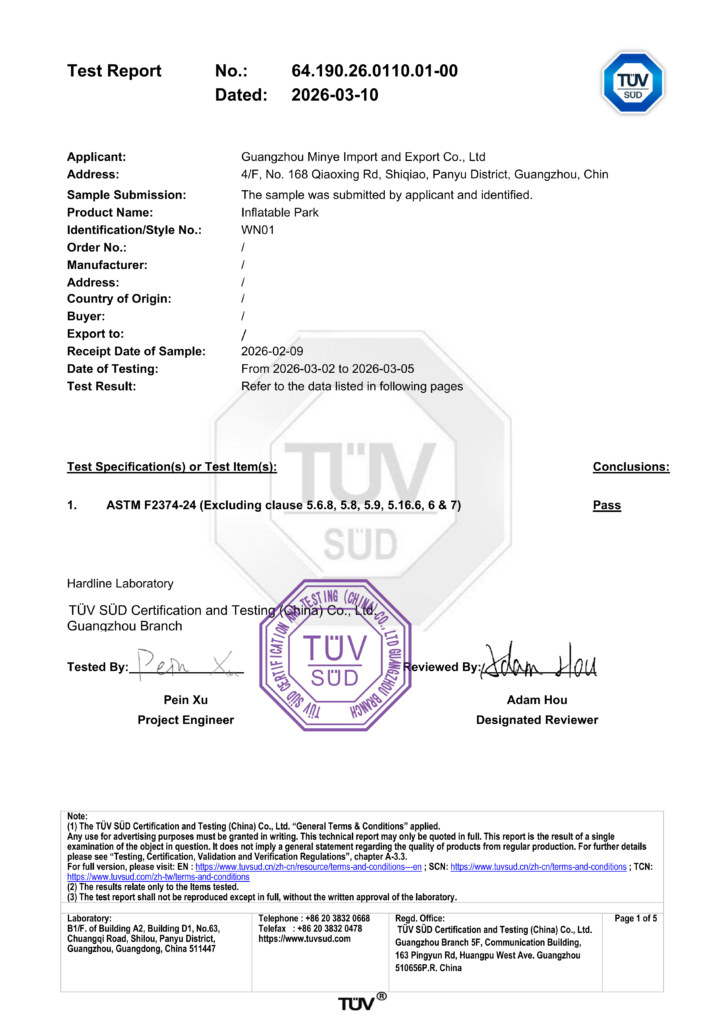
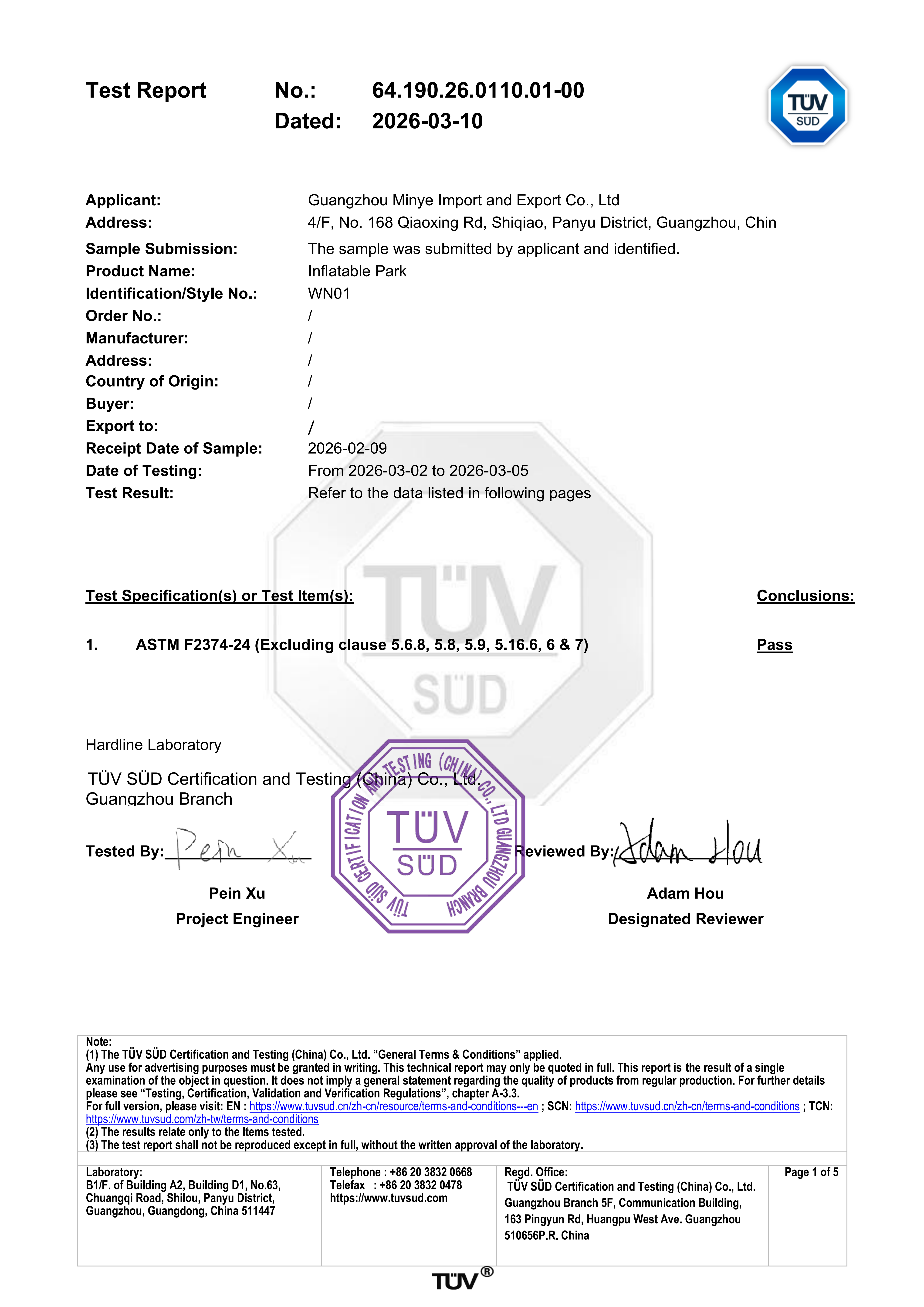
Guangzhou MinyeFun Completed TÜV On‑Site ASTM F2374 Evaluation & Testing (March 2026)
Overview
Safety for commercial inflatables is not a slogan—it’s a system that combines design discipline, manufacturing control, and operational clarity. In March 2026, Guangzhou MinyeFun completed a TÜV on‑site evaluation and testing against ASTM F2374, a widely referenced standard practice for inflatable amusement devices.
This post explains what ASTM F2374 focuses on, what is typically reviewed during on‑site assessment, and how our product development and QC process supports safer, more inspection‑ready projects—especially for indoor connected inflatable parks with obstacles and climbing + net features.
What is ASTM F2374 and Why It Matters
ASTM F2374 is commonly used by inspectors, operators, and risk‑management teams as a reference for commercial inflatable amusement devices. It addresses practical safety topics across the product lifecycle, including design considerations (ingress/egress, containment, openings and entrapment prevention), structural integrity and stability verification, anchoring/securement concepts, labeling, operating instructions, and maintenance/inspection practices.
For venue owners and operators, alignment with ASTM F2374 helps reduce uncertainty during permitting, third‑party inspection, and daily operation—particularly for indoor connected layouts where guest flow, supervision visibility, and transitions between modules become critical.
TÜV On‑Site Evaluation (March 2026): What Was Reviewed
During the March 2026 on‑site work, TÜV reviewed safety‑critical features and documentation against ASTM F2374 expectations. While each project may differ, on‑site assessments typically focus on practical, measurable items such as:
1) Structural Integrity & Stability at High‑Stress Zones
Connected parks introduce concentrated loading at entrances, transition platforms, climbing points, and high‑traffic obstacle elements. On‑site verification commonly pays close attention to load‑bearing surfaces, reinforcement details, and stability under uneven (offset) loading.
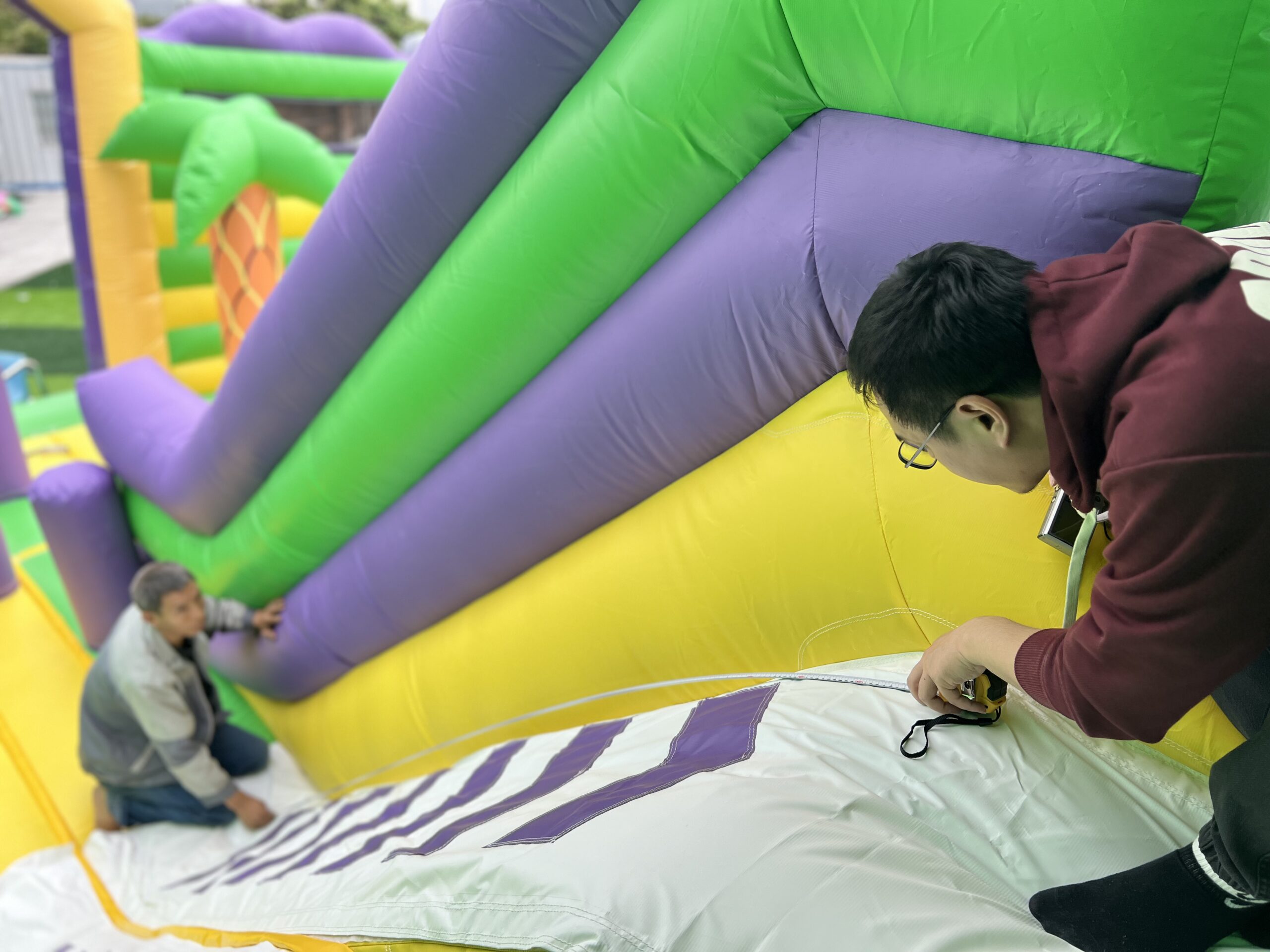
2) Ingress/Egress, Evacuation, and Deflation Considerations
Indoor inflatable parks are often evaluated for clear, usable ingress/egress paths and emergency egress considerations. Risk-reduction design measures in the event of power loss/deflation and the placement of blowers/inflation tubes (so they do not block access) are typical review items.
3) Openings, Entrapment Prevention, and Netting/Visibility
For obstacle + climbing parks, netting systems and opening geometries are critical. Reviews commonly emphasize designs that reduce entrapment hazards (including head/neck and finger/hand risks), secure net edge reinforcement and attachments, and visibility for attenda
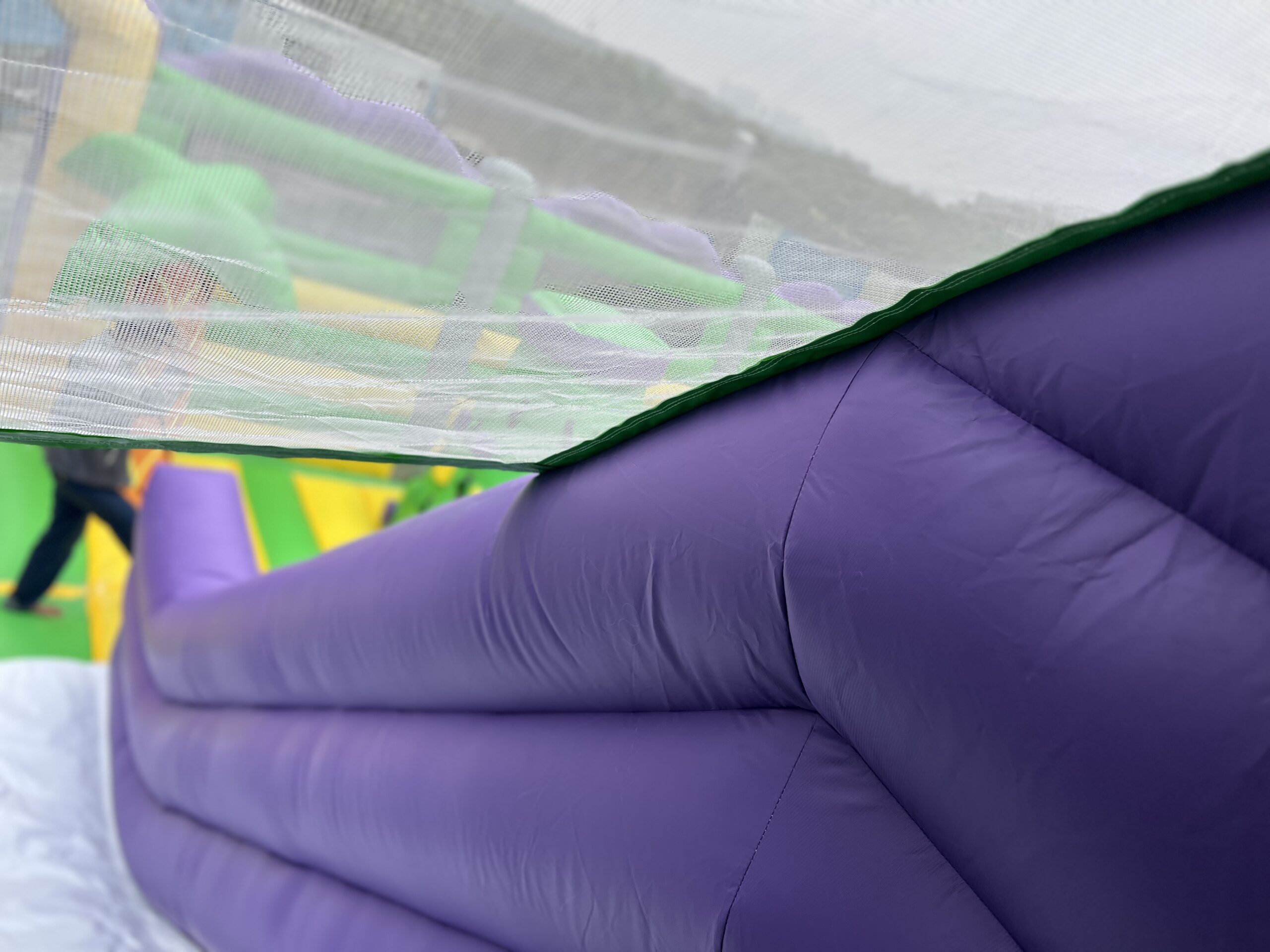
Caption: Netting/mesh inspection focusing on edge reinforcement and attachment points.
4) Anchoring / Indoor Securement Concepts and Operating Limits
Even indoors, securement is essential to prevent unintended movement. Reviews often cover the anchoring concept (indoor floor anchors, ballast, or structural fixed points), the declared operating limits, and clear setup guidance to ensure the equipment is installed as designed.
5) Labels and Operator Documentation
A strong safety system relies on clear information delivery. Typical checks include required warning/information labels, operator manual content (setup, supervision, inspection, maintenance, emergency actions), and practical daily inspection checklists.
How MinyeFun Builds for Safety: Engineering + QC
Completing on‑site assessment is not a one‑time event. It reflects daily discipline in engineering, manufacturing, and quality control. At MinyeFun, our process is designed to support inspection‑ready projects:
- Engineering review for connected layouts, traffic flow, and high‑risk zones (stairs, transitions, climbing).
- Reinforcement strategies at stress joints and high‑traffic areas (seams, anchors, climbing points).
- Incoming material checks and batch traceability for key components.
- In‑process QC with photo evidence for critical structures.
- OQC final inspection aligned to installation and operation realities.
Typical Configurations We Recommend (for Fast Quoting)
To make project planning easier and speed up quoting, below are three ready‑to‑customize configurations based on our most requested categories: custom mega parks, obstacle courses, and climbing + net parks. Each configuration can be tailored to your venue size, ceiling height, age group, and supervision plan.
Option A — Custom Mega Park (Family Flow, High Repeat Play)
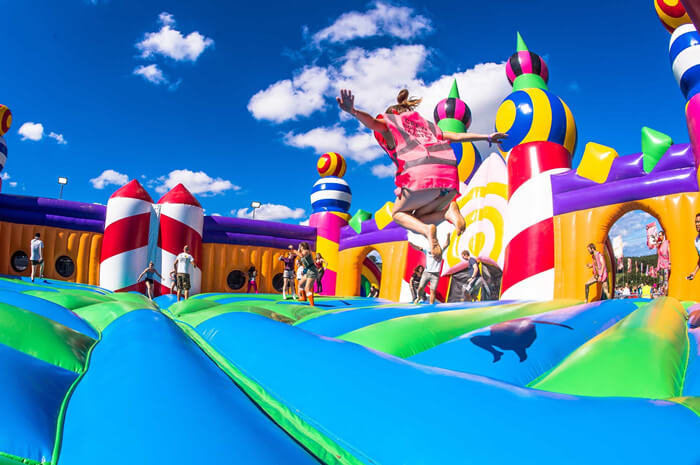
Recommended footprint: 150–450 m² (e.g., 15×10 m to 30×15 m)
Best for: FECs, shopping malls, indoor playgrounds, family venues
Typical modules:
- Central jump zone + perimeter obstacle loop for continuous circulation
- Soft obstacles (punch walls, pop‑ups, squeeze tunnels)
- 1–2 slide exits for throughput (with defined run‑out / landing concept)
- Entry/exit control point with queue area and clear sight lines
Optional upgrades: themed façades, branded arch, photo wall, LED accents
Option B — Obstacle Course Focus (Competition + Throughput)
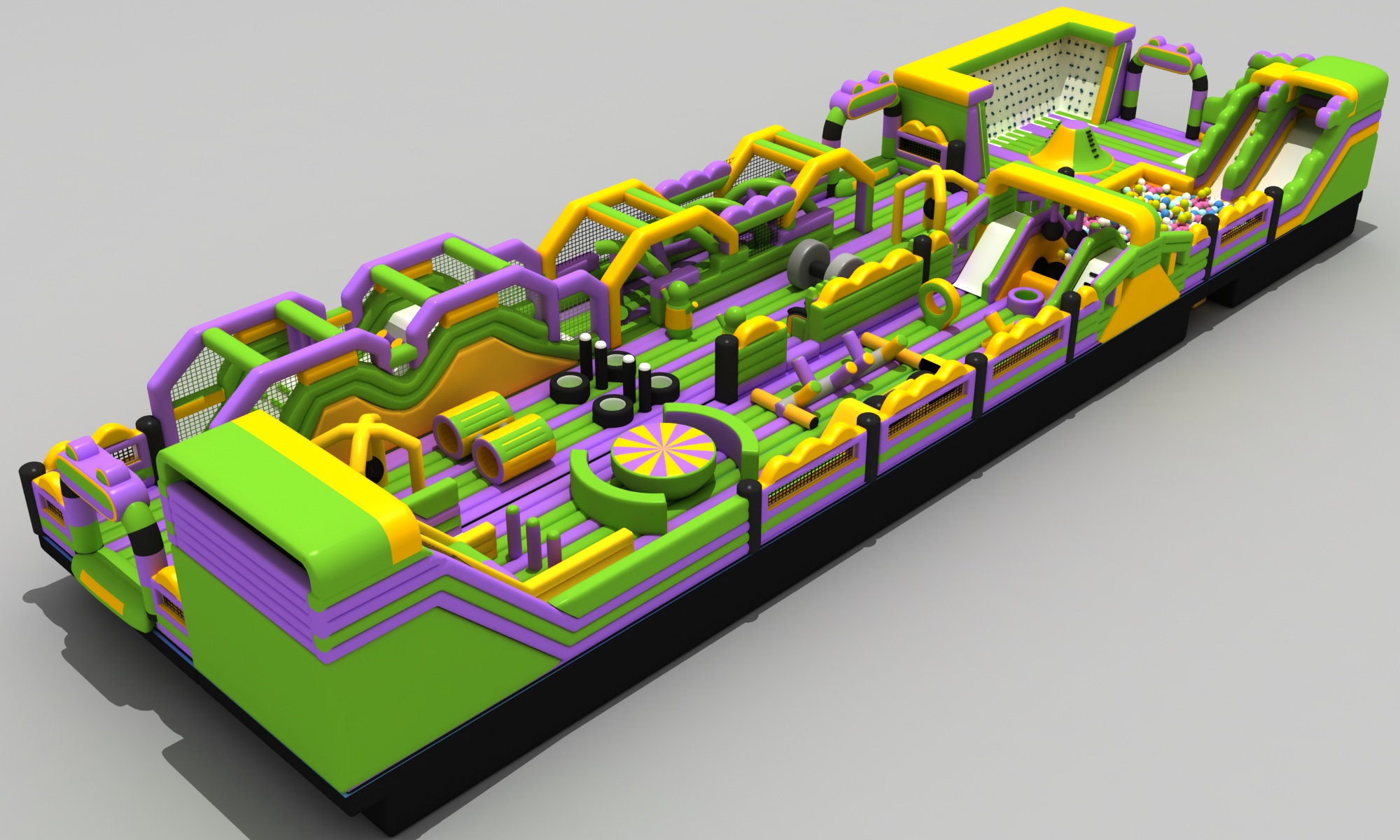
Recommended footprint: 160–420 m² (e.g., 20×8 m to 35×12 m)
Best for: ticketed attractions, events, youth centers, challenge parks
Typical modules:
- One-way course with start/finish gates (reduces head‑on collisions)
- Challenge elements: crawl tunnels, wedge climbs, balance beams, rolling logs
- Recovery zones at high‑energy sections to reduce pile‑ups
Optional upgrades: timing system integration, removable difficulty sections
Option C — Climbing + Net Park (Premium Look, Strong Engagement)
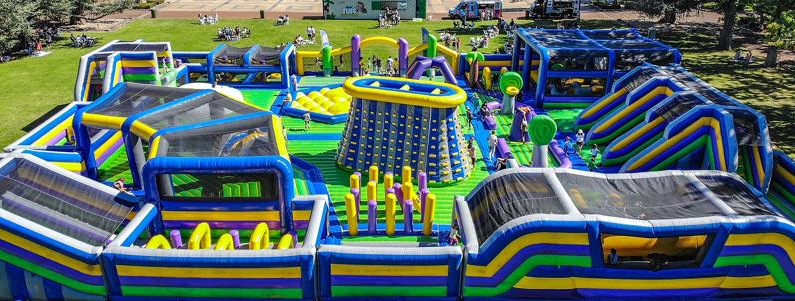
Recommended footprint: 180–540 m² (e.g., 15×12 m to 30×18 m)
Best for: premium indoor parks, modern FEC upgrades, ninja‑style play
Typical modules:
- Climbing walls, climb bridges, and climb nets with controlled access
- Netting zones designed for containment and supervision visibility
- Reinforced transition platforms at high‑stress points
- Slide or controlled exit zone with defined landing/run‑out area
Optional upgrades: reinforced net edge package, protective covers at high platforms, upgraded padding kit
Standard Deliverables for Connected Park Projects
For indoor connected parks, we can provide a documentation‑oriented package to support installation and operations, including:
- Layout suggestion (flow‑focused) + module list
- Blower plan and installation notes
- Daily inspection checklist + maintenance guidance
- Labels/warnings content suitable for commercial operations
Request a Compliance‑Oriented Quote
To receive a fast and accurate proposal, please share:
1) Venue size (L×W) and ceiling height
2) Target age group and your max rider weight policy
3) Preferred style: Custom Mega Park / Obstacle Course / Climbing + Net
4) Expected daily traffic (approx.) and target opening timeline
We will reply with a recommended configuration, an installation concept (blower & securement notes), and a quote‑ready module list.
FAQ
Q1: Can you share the TÜV certificate/report number publicly?
A: Yes. We can share the public certificate/report reference number and selected supporting materials where appropriate for your approval process.
Q2: Do you support indoor connected inflatable parks with obstacles and climbing + net features?
A: Yes. We specialize in indoor connected layouts and can help optimize flow paths, supervision visibility, and high‑risk zone design details.
Q3: What should we prepare for a venue approval or inspection?
A: Typically, you should prepare the installation layout, operator manual, daily inspection checklist, labeling photos, and a clear plan for securement/anchoring appropriate to your venue.