- One-Stop Supplier for Entertainment Games
- 86-137 1133 5861
- sales@minyefun.com

In recent years, big inflatable parks have rapidly expanded worldwide, becoming popular attractions in shopping malls, family entertainment centers (FECs), and commercial complexes.
Compared with traditional amusement rides, inflatable parks offer flexible investment, shorter setup time, and strong interactivity. However, truly successful projects are not defined by size alone.
For operators, a big inflatable park is fundamentally a long-term business, not a one-time equipment purchase.
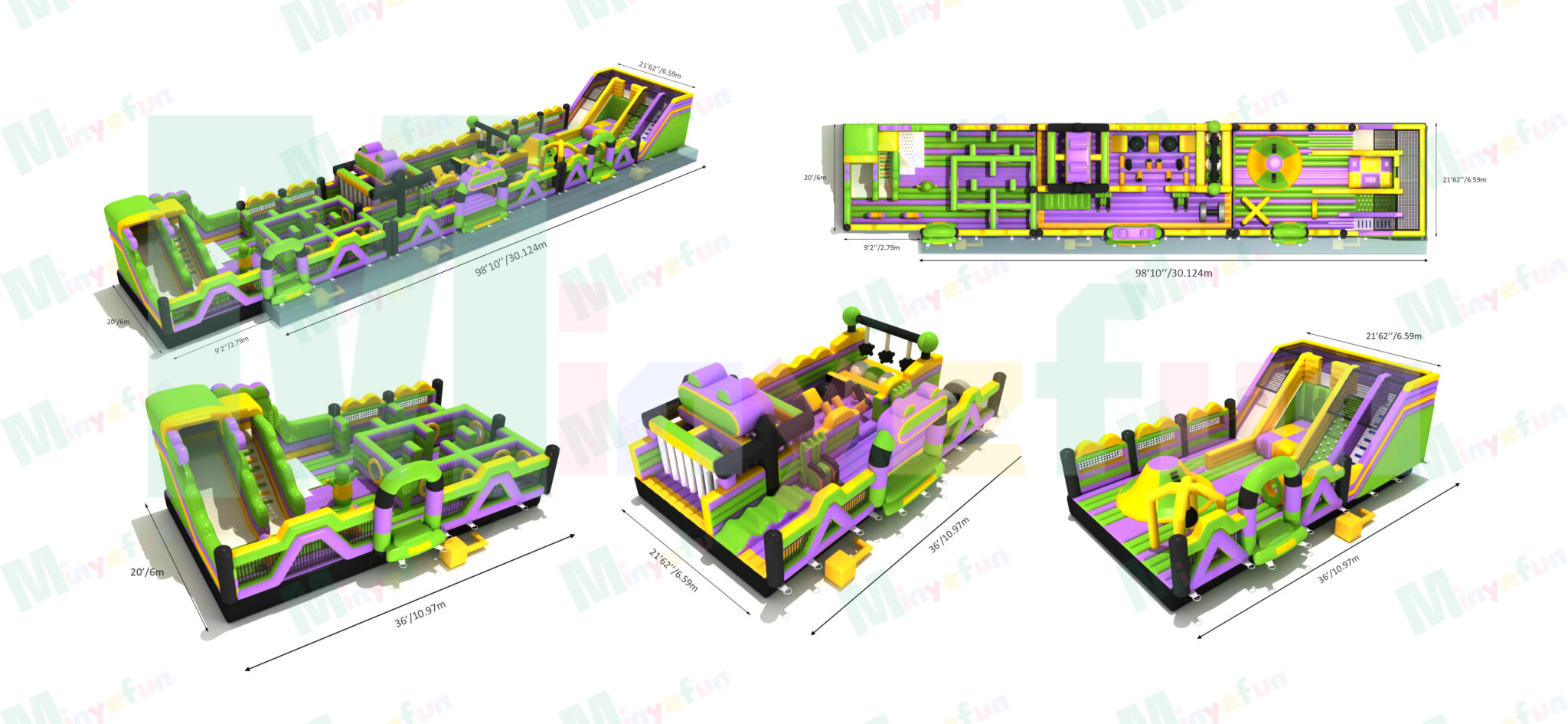
Many first-time investors focus heavily on size and appearance.
In real-world operation, success depends on several critical factors:
Structural safety and reliability
Peak-hour capacity
Daily operational stability
Long-term return on investment (ROI)
Only when these factors work together does scale translate into real commercial value.
A big inflatable park cannot simply be a collection of separate products.
Without proper planning, poor circulation, congestion, and difficult supervision can negatively impact both experience and revenue.
Professional park design includes:
Clear and smooth guest circulation
Logical zoning for different play areas and age groups
Layouts that allow easy supervision by staff
Good design significantly increases hourly capacity, especially during weekends and holidays.
Big inflatable parks operate in high-traffic public spaces, where safety directly affects brand reputation and liability risk.
Commercial-grade parks typically feature:
Reinforced high-impact and high-wear zones
Consistent and sustainable manufacturing standards
Designs that support regular inspection and long-term maintenance
In the long run, safety investment protects operational continuity and stable revenue.
In inflatable park operations, hourly guest capacity is often more important than total area.
Peak-hour throughput directly sets the revenue ceiling.
By optimizing circulation, reducing bottlenecks, and improving play continuity, mature parks can increase revenue without expanding space.
For large projects, frequent repairs, downtime, and excessive wear quickly reduce profitability.
That is why successful inflatable parks are designed from the beginning for high-frequency use and long-term operation.
Stable performance protects peak operating hours and ensures predictable returns.
Most successful inflatable parks evolve over time rather than remaining static.
Scalable designs allow operators to:
Add new modules
Adjust layouts or themes
Extend the overall commercial lifespan of the project
This flexibility is key to maintaining repeat visitors and long-term growth.
A big inflatable park is not just a set of inflatable products.
It is a long-term business decision combining design, safety, operations, and growth planning.
When scale, efficiency, and stability work together, big inflatable parks deliver sustainable, repeatable, and scalable long-term returns.